


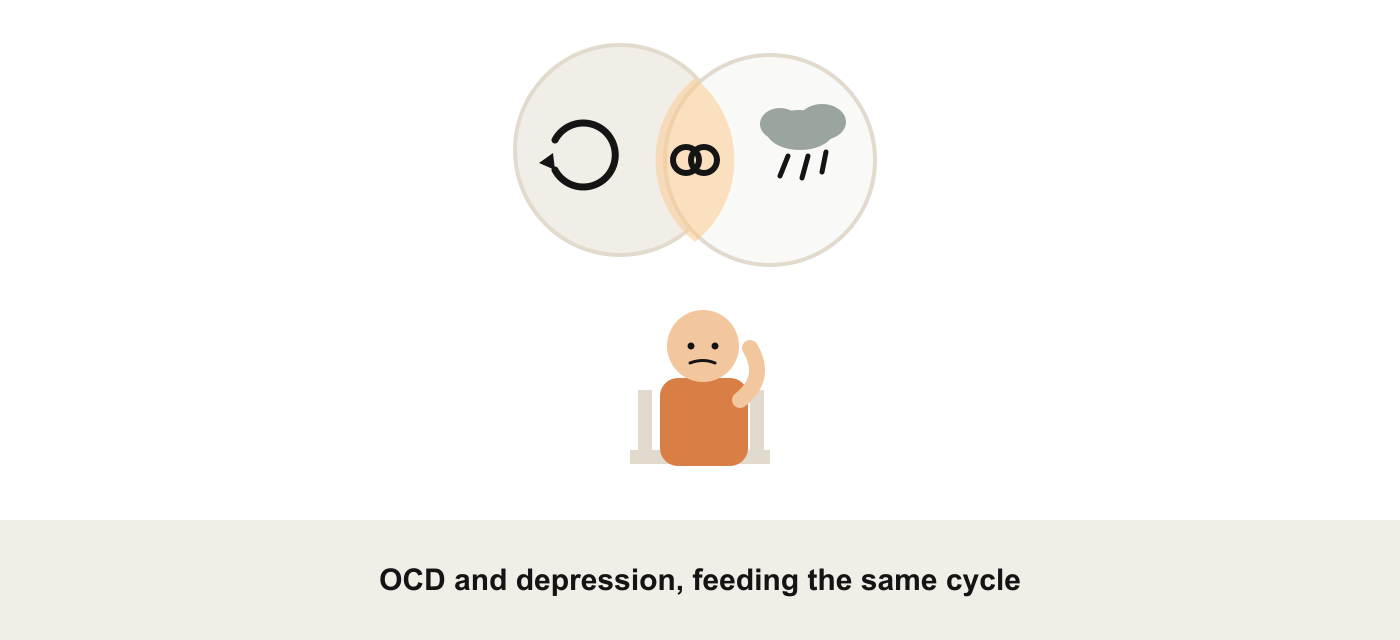
OCD and Depression: 7 Real Signs They Are Making Each Other Worse

OCD and depression showing up together is not a rare overlap or a coincidence of bad timing. It is one of the most common pairings in mental health, and it tends to follow a pattern: the exhausting, repetitive grip of obsessions and compulsions wears a person down until the low mood, hopelessness and loss of interest that define depression start to set in on top of it. Most people in this position are not dealing with two unrelated problems. They are dealing with one condition that has started to produce a second one.
That distinction matters because it changes what actually needs to happen next. Treating the depression alone, without touching the OCD underneath it, tends to leave the real engine still running. Treating the OCD without recognising a depression has developed on top of it can also stall, because depression saps exactly the energy and motivation that Exposure and Response Prevention requires. Knowing how OCD and depression interact, and what the real warning signs look like, is the first step toward getting a treatment plan that addresses both rather than chasing one symptom at a time.
Quick answer: OCD and depression occur together far more often than chance would predict, with research estimating that somewhere between a quarter and two-thirds of people with OCD will also experience a major depressive episode. In most cases, the OCD comes first and the depression develops as a response to how exhausting and demoralising living with unmanaged OCD actually is.
The clearest signs both are present include losing interest in things that used to matter outside of OCD itself, a drop in energy severe enough to make resisting compulsions feel impossible, and compulsions that keep running even once the anxiety behind them has gone quiet. Specialist treatment that addresses the OCD directly, rather than treating the depression in isolation, is usually what actually breaks the cycle.
Why OCD and Depression Show Up Together So Often
The scale of the overlap is larger than most people expect. The International OCD Foundation estimates that between a quarter and half of people with OCD will also meet the criteria for a major depressive episode at some point, and most of those people report that their OCD symptoms started first, with the depression following as a reaction to the distress of living with it rather than the other way round.
That sequence makes sense once you sit with what OCD actually demands of someone day to day. Hours spent on rituals, a mind that will not let an intrusive thought go, constant checking or reassurance-seeking that never quite resolves anything, and a creeping sense that the OCD is running the day rather than the other way round. Living inside that long enough, without the OCD itself being treated, is a reasonable thing to feel hopeless about. The depression that follows is not a separate problem arriving by coincidence. It is frequently a direct response to an underlying condition that has gone unaddressed for too long.
The Cycle: How OCD and Depression Feed Each Other
Once both are present, they tend to reinforce one another rather than sit side by side independently. OCD drains energy and motivation through the sheer repetition of obsessions and compulsions, and depression further lowers both, which makes resisting a compulsion in the moment feel far harder than it would otherwise. A person who might ordinarily manage to sit with an urge and let it pass can find that same urge unmanageable on a day when depression has already used up most of their reserve.
The reverse direction matters too. Depression on its own tends to respond to activity, connection and small wins. OCD actively works against all three, since compulsions eat the time and energy that might otherwise go toward the things that lift mood, and avoidance driven by OCD can quietly shrink a person's world until there is very little left to feel good about. This is why the two conditions, once both present, rarely improve on their own simply by waiting. Each one keeps the other supplied with exactly what it needs to continue.
Research estimates the overlap at somewhere between 12 and 68 percent of people with OCD reporting a major depressive episode at some point, a wide range that reflects how differently the two conditions can present depending on severity and how long the OCD has gone untreated. What the studies generally agree on is the direction of travel: depression tends to be secondary, arriving as a consequence of unmanaged OCD rather than the two conditions starting independently and happening to collide. That matters for treatment, because it points toward the OCD as the place to start looking for a cause, even when the depression is what eventually brings someone through the door.
7 Real Signs OCD and Depression Are Both Present
None of these signs are a diagnosis on their own, and a proper assessment is the only reliable way to confirm what is actually going on. They are, however, the pattern we see most often in people managing both conditions at once, and recognising it is usually the first step toward asking for the right kind of help.
Losing interest in things that used to matter to you, separate from anything OCD-related, like hobbies, friendships or plans you used to look forward to.
A drop in energy severe enough that resisting a compulsion, which used to be hard but possible, now feels completely out of reach most days.
Compulsions that keep running even on days when the anxiety behind them feels quiet, as if the ritual has become automatic rather than anxiety-driven.
A persistent sense of hopelessness about the OCD itself, a feeling that it will never actually improve regardless of what you try.
Sleep and appetite changes that go beyond what the OCD alone would explain, which is a classic depression marker rather than an anxiety one.
Withdrawing from people, not out of an OCD-driven avoidance of a specific trigger, but a general loss of motivation to see anyone at all.
Negative self-talk that has shifted from "I am anxious about this thought" to something closer to "there is something fundamentally wrong with me," which tends to track depression more than OCD on its own.
Telling OCD Avoidance Apart From Depressive Withdrawal
One of the trickier parts of spotting both conditions together is that OCD avoidance and depressive withdrawal can look similar from the outside, cancelling a plan, staying home, going quiet, while coming from genuinely different places. OCD avoidance is usually specific: a person avoids a particular situation, object or person because it triggers a particular obsession, and they can often name exactly why if asked directly.
Depressive withdrawal tends to be broader and less specific. It is not "I am avoiding this one thing because of a particular fear," but a general flattening of motivation that touches almost everything, including things that have nothing to do with OCD at all. A useful, informal check is asking whether the avoidance is tied to a specific trigger or thought, which points toward OCD, or whether it feels like a general loss of interest in almost everything, which points more toward depression. Many people have some of both running at once, which is exactly why a proper assessment matters more than trying to self-diagnose from a checklist.
Energy levels are worth watching separately from motivation. Someone with OCD alone often still has the underlying energy to do things they enjoy, even if a particular obsession is getting in the way that day. A drop in baseline energy that persists regardless of which obsession happens to be active, a tiredness that does not lift even on a day with no particular trigger, tends to point toward depression layering on top rather than OCD alone accounting for everything.
Why Treating Only One Half Often Does Not Work
A common pattern we see is someone who has been treated for depression, sometimes for years, without the underlying OCD ever being identified or addressed. Mood may lift slightly with general talking therapy or medication, but it tends to plateau, because the thing actually driving the exhaustion, the OCD itself, was never the target. The International OCD Foundation makes the same point from the other direction: severe depression can actively interfere with Exposure and Response Prevention, the treatment that research consistently shows works best for OCD, because ERP asks for a level of active engagement and tolerance of discomfort that depression makes genuinely harder to access.
This is why a specialist assessment matters more here than it might for either condition alone. Treating depression without recognising the OCD underneath it tends to leave the real engine running. Jumping straight into intensive OCD treatment without accounting for a depression severe enough to blunt someone's capacity to engage with it can set a person up to struggle with a method that would otherwise work well for them. The right order and combination depends on which symptoms are more severe, and that is a clinical judgment, not something to guess at alone.
What the Symptoms Actually Look Like Side by Side
Depression on its own has a fairly well-documented symptom picture, covered in detail on the NHS's own page on depression symptoms, including low mood, loss of interest, changes in sleep and appetite, and a pervasive sense of hopelessness. Several of these can overlap with how unmanaged OCD already feels day to day, which is exactly why the two conditions get missed as separate things for so long. A person already exhausted and demoralised by OCD may not notice that a second, related condition has developed on top of it, since much of what depression adds can feel like "more of the same" rather than something new.
The practical difference worth paying attention to is persistence and breadth. OCD-driven low mood tends to lift, at least somewhat, in moments away from a trigger. Depression tends not to lift in the same way, sitting underneath good days and bad days alike rather than tracking closely with whatever the OCD happened to focus on that day.
When to Get Help
If either condition, OCD or depression, is affecting your ability to work, maintain relationships, or get through an ordinary day, that is a reasonable point to seek a proper assessment rather than continuing to manage alone. This is especially true once both appear to be present, since the combination tends not to resolve on its own and responds far better to treatment aimed at both together than to either one in isolation.
It is worth saying plainly that noticing these signs in yourself is not a failure, and it does not mean previous treatment, for either condition, was wasted. Mood that lifted partly under general talking therapy, or OCD symptoms that improved somewhat without the depression being named, are both genuine progress. Recognising the fuller picture now is simply the next, reasonable step, not evidence that something earlier went wrong.
If low mood ever moves into thoughts of harming yourself, or you simply do not feel safe, that goes beyond what any article can responsibly help with. Contact your GP urgently, call 111, or in the UK reach the Samaritans free, any time, on 116 123. That support exists exactly for moments like this, and reaching out is not a failure of any treatment you have tried.
How Specialist OCD Treatment Addresses Both
OCD Excellence has worked in OCD specifically since 2003, and every therapist on the team has either lived experience of OCD themselves or has cared for someone close to them who has it. That background matters here because spotting the difference between OCD-driven exhaustion and a genuine depressive episode sitting on top of it takes real familiarity with how OCD actually presents, not just general mental health training.
A proper assessment looks at both conditions together rather than treating whichever one happens to be more visible, and builds a plan around what is actually driving your particular presentation, whether that means addressing the OCD first through Exposure and Response Prevention, bringing in additional support for the depression alongside it, or sequencing the two in a specific order. You can read more about who we treat and how if you want a fuller picture of what a specialist assessment actually involves before deciding whether it is the right next step.
If this pattern sounds familiar, from either direction, the most useful next step is usually a specialist OCD assessment, not waiting to see which condition improves first on its own. Our separate post on what OCD therapy actually involves covers what a properly structured course of treatment looks like from assessment onward, and our post on red flags in OCD therapy covers what to watch for if you are already in treatment that does not seem to be working for either condition.
Common Questions About OCD and Depression
Does OCD cause depression, or is it the other way round?
Most research and clinical experience points to OCD coming first in most cases, with depression developing afterward as a response to the distress and exhaustion of living with unmanaged OCD. It is possible for the reverse to happen, but it is less common.
Can antidepressants treat both OCD and depression at once?
Some medications used for OCD, typically SSRIs at a higher dose than is used for depression alone, can help with both conditions for some people, but this is a decision for a GP or psychiatrist based on your specific situation, not something to start or adjust based on general information here.
Is it normal to feel hopeless about OCD ever improving?
It is common, but it is also one of the clearer signs that a depressive episode may have developed alongside the OCD, rather than being an accurate prediction about treatment outcomes. OCD responds well to specialist, ERP-based treatment, even when it does not feel that way from inside a depressive low.
Should I get treated for depression first, or OCD first?
This depends on which symptoms are currently more severe and is genuinely a clinical judgment rather than a general rule. A proper assessment is the only reliable way to decide the right order, or whether both need addressing at the same time.
Can treating the OCD actually improve the depression without treating it directly?
Often, yes, particularly when the depression developed as a direct response to the OCD rather than arriving independently. Many people notice their mood lifting once the OCD itself is properly addressed, though more severe or longer-standing depression may still need its own dedicated support alongside OCD treatment.
How do I know if it is just a bad week or something more serious?
A bad week tends to lift with time, rest or a change in circumstances. If low mood, loss of interest or hopelessness has persisted for several weeks, is affecting your ability to function day to day, or is paired with thoughts of self-harm, that is a reasonable point to seek a proper assessment rather than waiting to see if it passes on its own.


Comments