


OCD Therapy: What It Actually Involves, the Types That Work, and What to Expect

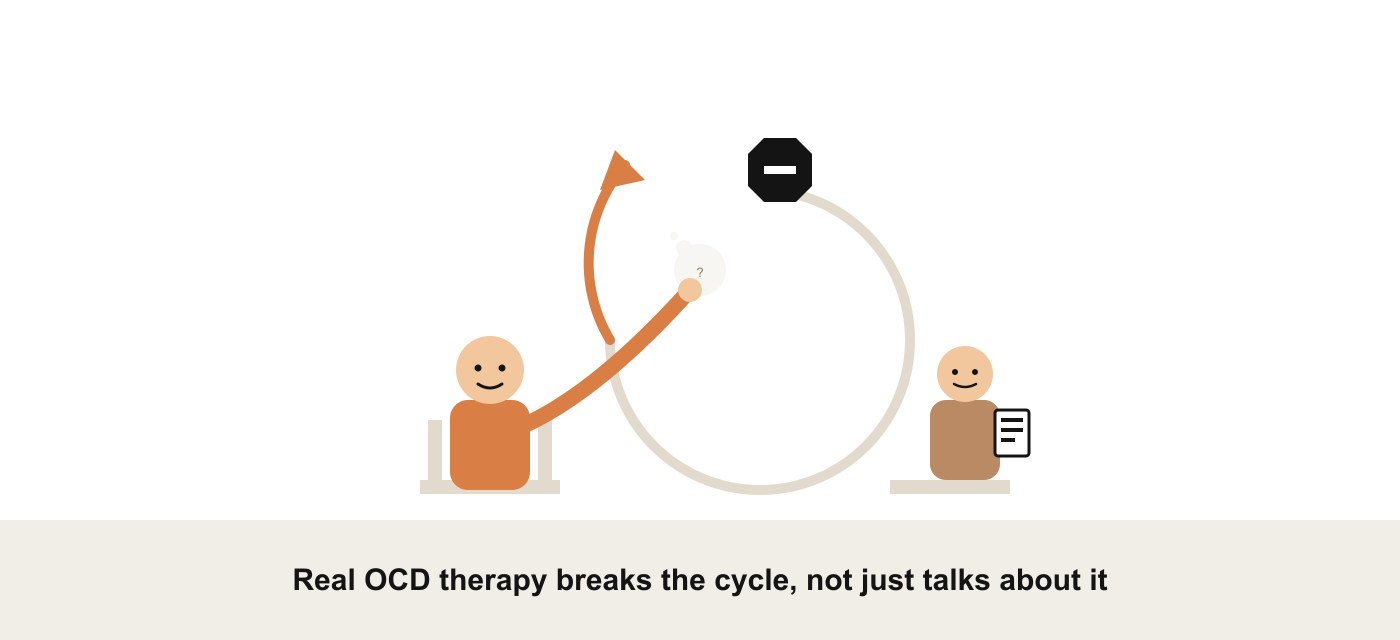
OCD therapy is not the same thing as general counselling, and treating it like a regular talking-therapy appointment is one of the most common reasons people feel stuck after months of sessions. Real OCD therapy has a specific structure, a specific goal, and a specific set of techniques built around breaking the obsession-compulsion cycle rather than simply discussing it. If you are trying to work out what actually happens in OCD therapy, which type you need, and what a genuine session looks like, this post covers it directly.
This is a broad, practical guide to OCD therapy itself: the types that are actually proven to work, what separates OCD therapy from standard CBT or counselling, what a session involves from the first appointment onward, and how to tell whether the therapy you are getting (or considering) is the right fit for OCD specifically.
Quick answer: effective OCD therapy means Cognitive Behavioural Therapy that includes Exposure and Response Prevention (ERP), not CBT alone. ERP works by gradually facing the thoughts, situations, or sensations that trigger obsessions while deliberately not performing the usual compulsion, so the brain learns the feared outcome will not happen and the anxiety fades on its own. A typical course runs 12 to 20 sessions, starts with a structured assessment and exposure hierarchy, and is recognised by NICE as the first-line treatment for OCD.
What OCD Therapy Actually Involves, Session by Session
OCD therapy generally follows a recognisable shape, even though the specific exposure tasks differ hugely from person to person depending on subtype and severity:
A structured assessment in the first one or two sessions, covering your specific obsessions, compulsions, avoidance patterns, and how much time OCD is taking from your day, used to confirm subtype and severity rather than guess at a generic plan
Building an exposure hierarchy together, a ranked list of feared situations or thoughts from mildly uncomfortable to genuinely difficult, so exposure work has a clear, agreed structure rather than starting with the hardest fear first
Weekly (or more frequent, in an intensive format) Exposure and Response Prevention sessions, each one working through the hierarchy while deliberately resisting the compulsion that would normally follow
Homework between sessions, since OCD therapy depends on practising exposure outside the therapy room, not just talking about it once a week
Regular review of progress against the goals set at assessment, adjusting the hierarchy as earlier exposures stop being difficult and new ones take their place
None of this looks like typical talk therapy, where a session might mostly involve discussing feelings or recent events. A genuine OCD therapy session spends real time on a specific exposure task, agreed in advance, with the therapist actively guiding you through it rather than just listening.
The Types of OCD Therapy: CBT, ERP, and What the Difference Actually Means
People often use "CBT" and "OCD therapy" interchangeably, but this is where a lot of wasted time comes from. Standard CBT, the kind used for depression or general anxiety, focuses on challenging and reframing negative thoughts. For OCD, that approach tends to backfire: arguing with an intrusive thought or trying to prove it false just feeds the compulsive checking and reassurance-seeking cycle it is supposed to calm.
CBT alone: teaches you to examine and reframe thoughts. Useful for many conditions, but a weak match for OCD on its own, since OCD compulsions are often mental rather than behavioural and reframing can itself become a new compulsion
Exposure and Response Prevention (ERP): the specific, evidence-backed form of CBT built for OCD. You face the trigger and resist the compulsion, rather than discussing or reframing the thought that triggers it
ERP with a cognitive component (I-CBT or similar): some therapists blend a small amount of thought-pattern work into an ERP-led programme, useful for certain presentations, but ERP remains the core mechanism doing the actual work
Medication alongside therapy: SSRIs are sometimes prescribed alongside OCD therapy, usually for more severe presentations, as a support to therapy rather than a replacement for it
If a therapist offers "CBT for OCD" without describing exposure work specifically, that is worth asking about directly. ERP is the active ingredient; CBT is simply the broader family of therapy it belongs to.
Why OCD Therapy Is Different From Regular Talk Therapy
This is the single biggest reason people feel OCD therapy "is not working" when actually what they received was not OCD therapy in the first place. A therapist without specific OCD training will often default to familiar, general techniques: discussing the thought, offering reassurance that the fear is unfounded, or encouraging relaxation. For OCD, every one of those responses accidentally reinforces the compulsion cycle instead of breaking it.
Our post on what actually makes someone an OCD specialist goes into this distinction in more depth, including the specific training and accreditation that separates a genuine OCD specialist from a generalist therapist willing to see OCD clients.
Reassurance in particular is worth naming directly, since it is the compulsion most often missed. Telling someone with contamination OCD "your hands are clean" or someone with relationship OCD "yes, your relationship is fine" feels supportive, but it is functionally the same as any other compulsion: it relieves anxiety in the moment and strengthens the obsession long term. Genuine OCD therapy is built to withhold that reassurance deliberately, which is uncomfortable for both the client and an undertrained therapist.
OCD Therapy by Subtype: Why the Exposure Tasks Change
The structure of OCD therapy (assessment, hierarchy, exposure, response prevention) stays consistent across subtypes, but the actual exposure tasks look completely different depending on what kind of OCD you have:
Contamination OCD: exposure often means handling specific objects or surfaces, deliberately skipping a washing ritual, and sitting with the discomfort rather than neutralising it
Responsibility and checking OCD: tasks focus on leaving a situation without checking, and tolerating real uncertainty about whether something was done correctly
Relationship OCD (ROCD): exposure centres on sitting with doubt about a relationship without seeking reassurance or mentally reviewing, a different skill from physical exposure work
Pure O and intrusive-thought-led presentations: tasks involve deliberately allowing an intrusive thought to occur without performing the mental compulsion that usually follows it
This is also why a generalist therapist, even one who understands ERP in principle, can build the wrong exposure hierarchy for the wrong subtype. Five sessions of the wrong kind of exposure work wastes the one real advantage OCD therapy offers: a hierarchy built specifically around your own obsessions, not a generic template.
What a Typical OCD Therapy Session Actually Looks Like
A real session usually runs 50 to 90 minutes. It typically opens with a short check-in on the previous week's homework, moves into the main exposure task for that session, often with the therapist actively present for part of the exposure rather than only discussing it afterward, and closes by agreeing the specific exposure homework for the week ahead.
Progress in OCD therapy does not always feel like anxiety disappearing. More often it looks like completing one fewer compulsion, delaying a ritual a little longer, or noticing an intrusive thought and choosing not to treat it as an emergency. Expecting dramatic, linear relief from session one is a common reason people give up on genuine OCD therapy too early, right before the approach actually starts to work.
How Long OCD Therapy Takes
A standard weekly course of ERP-based OCD therapy typically runs 12 to 20 sessions, though more severe presentations can need longer. Severity, how many subtypes or obsessions are present at once, and how consistently homework gets done between sessions all affect the real timeline more than any fixed number of weeks. For people whose weekly progress has stalled, or who want to move through the process faster, an intensive format compresses the same exposure work into a concentrated block of consecutive days instead of one session a week.
Our separate post on 5 day intensive OCD treatment in the UK covers exactly how that concentrated format works, including the real research behind it, if the usual weekly pace is not the right fit for your situation.
Common Reasons OCD Therapy Does Not Work the First Time
A lot of people try OCD therapy once, feel it did not help, and conclude therapy itself is not the answer for them. In most cases of a failed first attempt, the problem was not therapy in general but one of a few specific, fixable issues:
The therapist used general CBT or supportive counselling rather than ERP specifically, so the obsession-compulsion cycle was discussed rather than actually broken
The exposure hierarchy was built too fast, starting with the hardest fears before smaller, more manageable exposures built confidence and skill
Reassurance was given during sessions instead of withheld, which soothed anxiety in the room but strengthened the compulsion long term
Homework between sessions was skipped or treated as optional, when the exposure practice outside the session is where most of the real change happens
A co-occurring condition, such as depression or generalised anxiety, was never assessed for and ended up interfering with the OCD-specific work
None of these point to OCD being untreatable. They point to a mismatch between the therapy received and what OCD specifically requires, which is exactly why checking for genuine ERP, a real exposure hierarchy, and specific OCD training matters more than simply finding any available therapist.
What to Expect From Your First OCD Therapy Session
The first session of real OCD therapy looks noticeably different from a first counselling appointment. Expect a structured conversation about your specific obsessions and compulsions, roughly how many hours a day they take up, what you currently avoid because of them, and whether family members or a partner have become involved in your rituals through reassurance or accommodation.
A genuine specialist will usually also ask about the history of your symptoms, any previous treatment and why it did or did not help, and any co-occurring conditions like depression or generalised anxiety that might need addressing alongside OCD specifically. You should leave the first session with at least a rough sense of your subtype, a provisional severity level, and what the early exposure hierarchy might look like, not just a plan to "talk again next week."
It is reasonable to ask a prospective therapist directly, before committing to a course of sessions, whether ERP will form the core of the work and how they build an exposure hierarchy. A genuine OCD specialist will answer both questions specifically and without hesitation.
What the Research Actually Says
OCD therapy built around ERP is not a niche preference among specialists; it is the recommended first-line treatment. The National Institute for Health and Care Excellence names CBT with ERP as the first-line approach for OCD in the UK, and the International OCD Foundation describes ERP as the gold-standard, most extensively researched treatment for the condition.
A systematic review and meta-analysis of ERP combined with medication found consistently stronger outcomes for people who received ERP specifically, rather than general supportive therapy or medication alone, reinforcing why the specific technique used in a session matters as much as simply attending therapy regularly.
In Person, Online, or Intensive: The Formats OCD Therapy Comes In
OCD therapy does not have to mean a weekly in-person appointment at a fixed clinic. The same ERP-based approach can be delivered in person, online over video, or compressed into an intensive block, depending on what your specific exposure work actually needs and how your life is set up around it.
Location-specific detail on cost, format, and what an assessment involves is covered in our post on OCD treatment in London, including how the weekly and intensive formats compare side by side.
How to Tell You Are Getting Genuine OCD Therapy, Not Just Generic CBT
Since OCD therapy is so easy to mistake for general CBT or counselling, here are 7 real signs the therapy you are getting is actually built for OCD:
Your therapist asks about compulsions specifically, not just feelings or mood, within the first session or two
An exposure hierarchy exists and is agreed with you, not just a loose conversation about your triggers
You are given specific exposure homework between sessions, not general reflection prompts
Your therapist does not offer reassurance when you ask for it, and explains why withholding it matters
Progress is measured against reduced compulsions and avoidance, not just how you feel talking about them
Your therapist can describe their specific OCD or ERP training, not just general CBT qualifications
Sessions involve active exposure work, not only discussion of the week's events
If several of these are missing, it is worth asking your therapist directly whether ERP is part of the plan, or looking for a therapist with specific OCD accreditation instead.
The real starting point for genuine OCD therapy is a proper specialist assessment, not a general counselling appointment. You can read more about who we treat and how, or go straight to booking an assessment to find out what a real ERP-based programme would look like for your specific OCD.
Common Questions About OCD Therapy
What is the most effective type of OCD therapy?
Cognitive Behavioural Therapy that includes Exposure and Response Prevention (ERP) is the most effective, evidence-backed OCD therapy. ERP specifically, not general CBT alone, is what NICE and the International OCD Foundation both name as the first-line treatment.
How is OCD therapy different from regular CBT?
Regular CBT focuses on challenging and reframing thoughts, which can feed OCD's reassurance-seeking cycle. OCD therapy centres on Exposure and Response Prevention instead: facing the trigger and resisting the compulsion, rather than discussing or reasoning with the thought itself.
How many sessions of OCD therapy do you need?
A standard weekly course typically runs 12 to 20 sessions, though this varies with severity. An intensive format can compress the same core exposure work into a concentrated block of consecutive days for people who want to move faster.
Can OCD therapy be done online?
Yes, for most subtypes. The same assessment, exposure hierarchy, and ERP structure works over video. Some highly environment-specific exposure work can benefit from being in person, which is worth raising directly at assessment.
Does OCD therapy actually work?
Yes. Exposure and Response Prevention is the most researched treatment for OCD, with consistently stronger outcomes than general supportive therapy or medication alone in published reviews, though results depend on receiving genuine ERP rather than general CBT.
Is medication needed alongside OCD therapy?
Not always. Medication, usually an SSRI, is sometimes prescribed alongside therapy for more severe presentations, as a support to the therapy rather than a replacement for it. A specialist assessment is what actually determines whether it is needed.
How do I know if my therapist is a genuine OCD specialist?
Ask directly about their specific ERP training and accreditation, whether they build an exposure hierarchy with you, and whether they give specific exposure homework rather than general reflection. A generalist therapist willing to see OCD clients is not the same as a trained OCD specialist.


Comments