


OCD vs Panic Attacks: 6 Real Differences People Get Wrong

OCD vs panic attacks is a confusion that makes complete sense once you have lived through either one. Both can hit with a racing heart, a sense that something terrible is about to happen, and a feeling of being completely out of control of your own body. From the outside, and often from the inside too, a panic attack triggered by an intrusive thought can look identical to a panic attack that arrives out of nowhere.
They are not the same thing, and the difference matters for more than diagnostic tidiness. A panic attack that happens on its own, with no obsessive thought behind it, usually responds to panic-focused treatment. A panic attack that is really OCD wearing a different face responds to something else entirely, and treating it as plain panic disorder can leave the real driver, the obsession and the compulsion built to manage it, completely untouched.
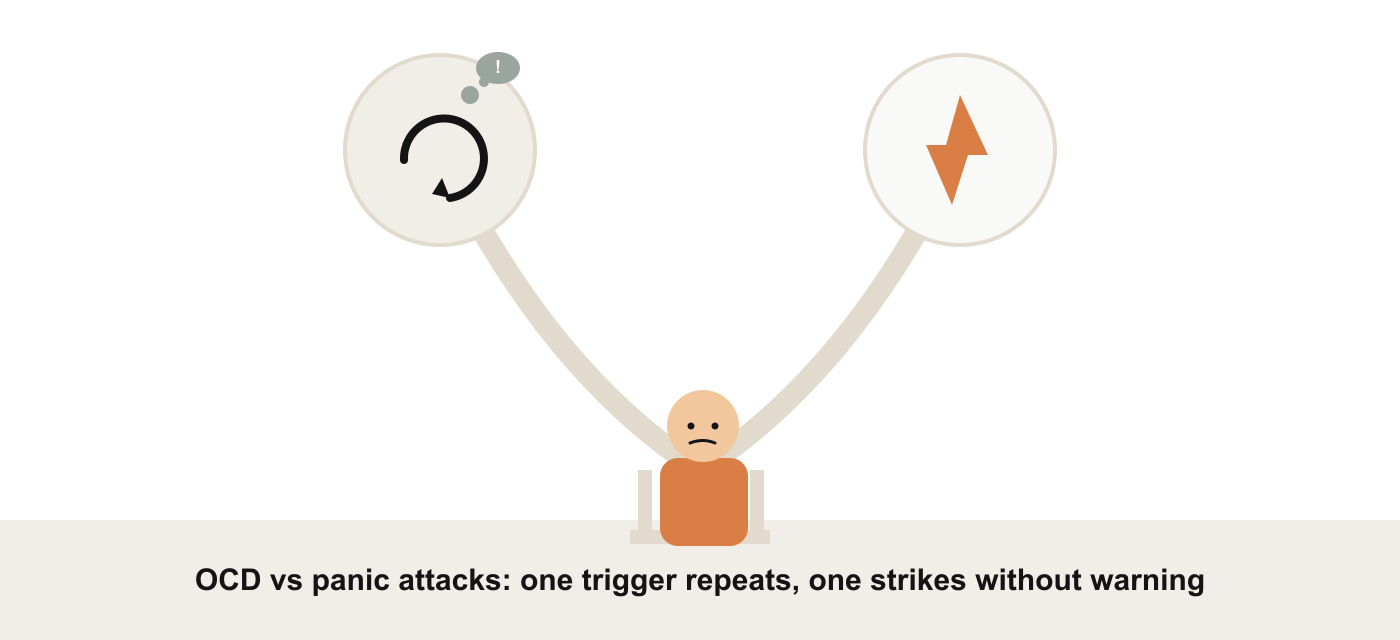
Quick answer: panic disorder involves panic attacks that arrive suddenly and unpredictably, with the fear centered on the attack itself, such as fear of a heart attack or losing your mind. OCD-triggered panic follows a specific obsessive theme, such as contamination or harm, and the panic is a reaction to that particular intrusive thought rather than a standalone event.
A useful test is asking whether the panic always follows the same kind of thought or situation. If it does, that points toward OCD. If it arrives with no clear thought behind it and the fear is about the attack itself, that points toward panic disorder. Many people have genuine symptoms of both, and a proper specialist assessment is the only reliable way to tell.
Why OCD and Panic Attacks Get Confused So Often
The physical symptoms overlap almost completely. A pounding heart, shortness of breath, dizziness, sweating, a feeling of unreality, a surge of dread. Whether that surge was triggered by an intrusive thought about contamination or arrived with no obvious cause at all, the body produces more or less the same alarm response. Nobody mid-attack is calmly cataloguing which diagnostic category they are experiencing.
The overlap is not just symptomatic. The two conditions are genuinely comorbid, meaning they occur together at rates well above chance. Research looking at over a thousand OCD patients found a lifetime rate of panic disorder and agoraphobia combined of around 20 percent, a figure covered in detail in the International OCD Foundation's own research area on OCD comorbidities.
A separate point worth naming directly: PsychCentral's own piece on telling anxiety and OCD apart makes clear this confusion is common enough to warrant its own explainer, not a rare edge case. If you have ever searched for the difference yourself, you are in good company.
What a Panic Attack on Its Own Actually Looks Like
Panic disorder centers on repeated, unexpected attacks that arrive with no obvious trigger, plus ongoing worry about when the next one will hit. The physical peak usually arrives within about ten minutes: racing heart, chest tightness, trembling, a sense of detachment from your own body, and often a specific fear that something is happening to you physically or mentally right now, a heart attack, fainting, losing your mind completely.
The NHS's own page on panic disorder describes this pattern clearly: attacks that feel like they come from nowhere, followed by a real fear of having another one, which itself becomes exhausting and limiting over time even between attacks.
The key feature is that the fear is about the attack itself and what it might mean for your body or your sanity, not about a specific intrusive thought that triggered it. Someone with panic disorder alone is not usually trying to neutralise a particular obsession. They are reacting to the terrifying experience of the attack in its own right.
What an OCD-Triggered Panic Attack Actually Looks Like
OCD-triggered panic follows a different shape entirely, even though the body produces a similar response. Someone with contamination OCD might feel a full-blown panic attack arrive the moment they touch a door handle in a public toilet. Someone with harm OCD might panic after an intrusive thought about hurting someone they love flashes through their mind. The panic is not random. It is tied, every time, to the same kind of obsessive content.
That thematic consistency is the single biggest tell. The attack is a reaction to a specific thought being treated as a real and urgent warning sign, not a spontaneous event. Compulsions often follow close behind, washing, checking, mental reviewing, seeking reassurance, and those compulsions can bring short-term relief from the panic. The real problem is that the relief teaches the brain the thought was genuinely dangerous, which keeps the whole cycle running rather than closing it down.
The OCD vs Panic Attacks Cycle, in Practice
A typical sequence looks like this: an intrusive thought arrives, the brain interprets it as meaningful and dangerous rather than as the meaningless mental noise everyone experiences, anxiety spikes fast enough to become a full panic attack, a compulsion is performed to bring the panic down, and the relief is real but temporary. Next time the same thought appears, the brain has learned nothing except that panic plus compulsion equals relief, so the pattern repeats, often with the panic response getting faster and more intense over time rather than fading.
6 Real Differences Between OCD and Panic Attacks
None of these are a diagnosis on their own. They are the pattern a specialist assessment actually looks for, and recognising it in yourself is a reasonable first step before seeking one.
Trigger specificity: OCD-triggered panic follows the same obsessive theme every time (contamination, harm, a particular fear); panic disorder attacks often arrive with no identifiable trigger at all.
What the fear is actually about: in OCD, the fear is about the thought itself and what it might mean about you; in panic disorder, the fear is about the attack, your body, or your mind giving out.
What happens after: OCD panic is usually followed by a compulsion aimed at neutralising the thought; panic disorder attacks are usually followed by avoidance of situations where another attack might happen.
Predictability: panic disorder attacks are often described as coming "out of the blue"; OCD panic is far more predictable once you know the person's specific obsessions.
What resisting looks like: resisting an OCD compulsion (not washing, not checking) tends to reduce panic over repeated practice, which is the basis of Exposure and Response Prevention; avoiding a panic trigger tends to make panic disorder worse over time, not better.
Comorbidity pattern: the two frequently occur together rather than instead of each other, so "which one is it" is sometimes genuinely "both," confirmed in research showing roughly 20 percent lifetime overlap.
A Simple Way to Tell Them Apart
Ask whether the panic always follows the same kind of thought or situation. If a person can reliably say "this happens when I think about X" or "this happens when I touch Y," that consistency points toward OCD. If the panic genuinely seems to arrive at random, with no thought behind it that the person can identify, that points more toward panic disorder on its own.
A second useful check is what happens during calm, trigger-free stretches. Someone with panic disorder alone can still feel generally at ease between attacks, aside from background worry about the next one. Someone with OCD-driven panic is often managing obsessive thoughts and small compulsions continuously, even on days without a full panic attack, because the underlying obsession never fully switches off.
Neither check replaces a real assessment. They are a starting point for recognising the pattern, not a substitute for a specialist actually reviewing your specific history.
Common Myths About OCD vs Panic Attacks
A few myths keep this confusion alive, and clearing them up tends to make the real pattern much easier to spot. None of these myths are malicious, they just reflect how similar the two experiences feel from the inside.
Myth: "A panic attack is a panic attack, the cause does not matter." In practice the cause changes almost everything about what helps, since OCD-triggered panic needs the obsession addressed directly while standalone panic disorder needs a different approach entirely.
Myth: "If I can name a trigger, it cannot be a real panic attack." Plenty of genuine, severe panic attacks have a clear trigger. Having a specific, consistent trigger is actually one of the clearer signs the panic is OCD-related, not a reason to doubt it.
Myth: "OCD is just about cleanliness, so if my panic is not about germs it cannot be OCD." OCD covers a wide range of obsessive themes, harm, relationships, morality, religion, health, far beyond contamination, and panic can attach to any of them.
Myth: "Once you know the difference between OCD vs panic attacks, you can self-diagnose from home." Recognising the pattern is a genuinely useful first step, but a proper assessment accounts for overlap, comorbidity and individual history in a way a checklist cannot.
What a Specialist Assessment Actually Looks At
When someone comes in unsure whether their panic is OCD, panic disorder, or both, a proper specialist assessment does not start by picking one label and working backward. It starts by mapping the pattern in detail: what thought, if any, comes immediately before each attack, whether that thought repeats across different attacks, what the person does afterward to feel better, and whether that action brings lasting relief or just a short-term dip in anxiety that creeps back later.
That mapping is what actually separates OCD vs panic attacks in practice, far more reliably than trying to self-diagnose from a single checklist. A therapist trained specifically in OCD will also know to ask about compulsions the person may not even recognise as compulsions, mental reviewing, silent reassurance-seeking, avoidance that has become so automatic it no longer feels like a choice, since these often go unreported in a general anxiety assessment that is not specifically looking for them.
This is also where lived experience on the clinical side genuinely helps. A therapist who has lived through OCD themselves, or cared for someone who has, tends to ask more precise follow-up questions about the texture of the panic: whether it eases the moment a compulsion is completed, whether the same exact thought triggers it every time, whether the fear is really about the thought or about the physical sensations themselves. Those distinctions are easy to miss from outside the experience and easy to recognise from inside it.
Why the Difference Changes What Treatment Actually Works
Panic-focused CBT for panic disorder typically works by helping someone sit with the physical sensations of panic without escaping them, gradually teaching the nervous system that the sensations themselves are not dangerous. Exposure and Response Prevention for OCD works differently: it targets the specific obsession and, critically, blocks the compulsion that would normally follow, so the brain learns the feared outcome does not happen even without the ritual.
Treating OCD-triggered panic as plain panic disorder misses this entirely. General panic treatment may help someone tolerate the physical sensations a little better, but if the underlying obsession and its compulsion are never addressed, the same thought will keep generating panic indefinitely. This is a genuinely common reason people report years of treatment for "anxiety" or "panic" with limited progress, when the real driver was an undiagnosed obsessive thought pattern underneath it the whole time.
When Both Are Genuinely Present
Because the comorbidity rate is real and significant (roughly 15 to 20 percent lifetime panic disorder in OCD patients, per the research covered in the International OCD Foundation's comorbidity research area), it is entirely possible to have both a standalone panic disorder and OCD-triggered panic at the same time. In that case, a single assessment needs to map out which attacks follow an obsessive theme and which genuinely arrive without one, since the two may need related but distinct treatment approaches running alongside each other.
This is exactly the kind of overlap that is hard to untangle alone and genuinely benefits from a specialist who works with OCD specifically, rather than general anxiety treatment that treats every panic attack as the same underlying thing.
How Specialist OCD Treatment Addresses This
OCD Excellence has worked in OCD specifically since 2003, and every therapist on the team has either lived experience of OCD themselves or has cared for someone close to them who has it. That matters here because telling OCD-triggered panic apart from standalone panic disorder takes real familiarity with how obsessions actually present, not just general anxiety training.
A proper assessment maps out whether your panic follows a specific obsessive theme, arrives without one, or genuinely involves both, and builds a treatment plan around what is actually driving it rather than treating every panic attack the same way. You can read more about who we treat and how if you want a fuller picture of what a specialist assessment actually involves.
If this pattern sounds familiar, the most useful next step is usually a specialist OCD assessment, rather than continuing to manage it as plain anxiety or panic alone. Our post on what OCD therapy actually involves covers what a properly structured course of ERP-based treatment looks like, and our post on OCD and depression covers another common comorbidity pattern worth recognising if low mood has crept in alongside the panic.
Common Questions About OCD vs Panic Attacks
Can OCD cause real panic attacks, not just anxiety?
Yes. A panic attack triggered by an intrusive thought produces the same physical symptoms as a standalone panic attack: racing heart, shortness of breath, a sense of unreality. The attack itself is real; what differs is what triggered it and what tends to follow it.
Is it possible to have both panic disorder and OCD at the same time?
Yes, and it is genuinely common. Research on OCD patients finds a lifetime panic disorder and agoraphobia rate of roughly 20 percent combined, well above general population rates, so having both is a realistic possibility rather than an unusual edge case.
Why does avoiding my panic trigger make OCD worse but not help panic disorder either?
Avoidance tends to reinforce both conditions over time rather than resolve either. For OCD, avoidance and compulsions teach the brain the obsession was a real threat worth avoiding. For panic disorder, avoiding situations linked to past attacks tends to shrink a person's world and increase anticipatory anxiety rather than reduce it.
Should I get treated for panic disorder first, or OCD first?
This depends on whether your panic is genuinely standalone, OCD-triggered, or both, which is a clinical judgment rather than something to decide alone. A proper assessment is the only reliable way to identify which pattern is actually driving your symptoms.
How do I know if my panic attacks are "just anxiety" or something more specific like OCD?
A useful starting signal is whether the panic reliably follows the same kind of thought or situation every time. If it does, that points toward an OCD-specific pattern worth having properly assessed rather than treated as general anxiety alone.


Comments