


CBT for OCD: 8 Real Ways It Differs From General CBT

Quick answer: CBT for OCD is a specific version of cognitive behavioural therapy built around exposure and response prevention (ERP). General CBT, the kind many therapists use for low mood or everyday anxiety, tends to focus on talking through worries, challenging unhelpful thoughts and teaching calming skills. With OCD, those same tools can turn into new compulsions. OCD-specific CBT works the other way round: you face the trigger on purpose, you drop the ritual, reassurance and mental checking, and you learn to live with the doubt instead of solving it. If your past therapy was mostly talking, relaxation or reassurance, you may not have had CBT for OCD at all.
Why CBT for OCD needs its own rules
CBT is a broad family of therapies. At heart it looks at how thoughts, feelings, body sensations and behaviour feed each other, and it gives you practical ways to break unhelpful loops. For depression, a CBT therapist might help you spot a thought like "I always fail" and test it against the evidence. For panic, they might help you see that a racing heart is not a heart attack.
That logic works well for many problems. OCD is different because the problem is rarely a lack of evidence. Most people with OCD already know, on some level, that the oven is off, that they did not hit anyone on the drive home, or that a passing thought about harming a child does not make them dangerous. They have looked at the evidence hundreds of times. The trouble is that OCD keeps demanding one more check.
So when a general CBT therapist asks "What is the evidence that you left the door unlocked?", the conversation can feel helpful for an hour and then feed the cycle for a week. Weighing up the evidence is exactly what the person has been doing compulsively. The session has become a polished, professional version of the ritual.
This is why the UK guidance does not just say "CBT". The NICE guideline on OCD and body dysmorphic disorder repeats the phrase "CBT (including ERP)" throughout its treatment recommendations, and the NHS page on OCD treatment says therapy for OCD "is usually a type of cognitive behavioural therapy (CBT) with exposure and response prevention (ERP)." The ERP part is not a bolt-on. It is the centre of the treatment.
Below are eight practical differences between CBT for OCD and the general CBT you might have tried before.
Difference 1: exposure is the main event
In general CBT, exposure might come up now and again, usually late in treatment, and sometimes not at all. In CBT for OCD, it is the backbone of most sessions.
The International OCD Foundation explains ERP like this: "The exposure component of ERP refers to practicing confronting the thoughts, images, objects, and situations that make you anxious and/or provoke your obsessions." That means sessions are often active. You might touch a door handle you have been avoiding, write out the thought you are most afraid of, leave the house without going back to check, or hold a kitchen knife while a loved one is in the room.
A good OCD therapist builds this up in steps with you. The NHS describes starting "with situations that cause the least anxiety first, before moving on to more difficult thoughts." You agree the steps together. Nobody springs a surprise on you, and nobody forces you into anything.
What separates this from general CBT is the amount of time spent doing it. If you have had twelve sessions of "CBT" for OCD and spent most of them talking about your childhood, your week or the reasons behind your fears, you have had something closer to talk therapy. That may have had some value for other parts of your life, but it is not the treatment the evidence points to for OCD.
Difference 2: response prevention, the part people skip
Exposure on its own is only half of ERP. The other half is what you do, or rather do not do, after the anxiety rises.
The IOCDF puts it plainly: "The response prevention part of ERP refers to making a choice not to do a compulsive behavior once the anxiety or obsessions have been 'triggered.'"
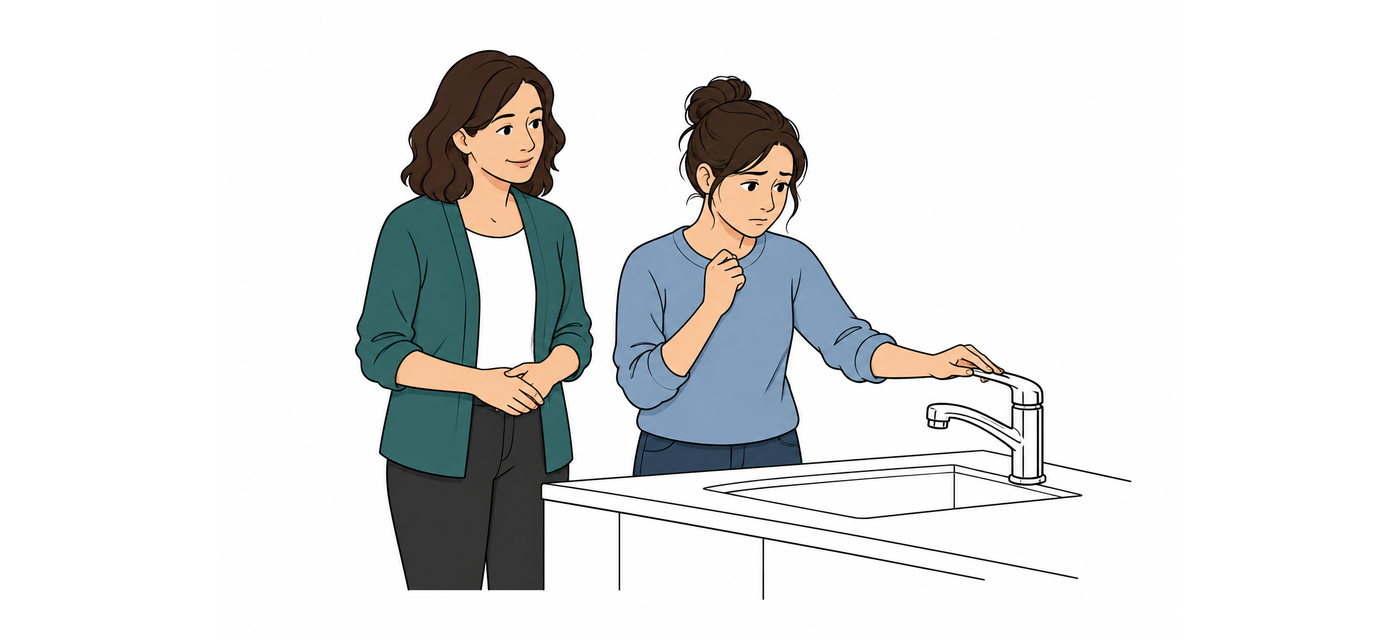
This is where a lot of therapy goes wrong. Someone with contamination fears might touch a bin as an exposure task, then quietly wash their hands for ten minutes once they get home. Someone with harm OCD might stand next to a busy road and then spend the evening replaying the scene to check they did not push anyone. The exposure happened, but the compulsion cancelled it out.
In CBT for OCD, your therapist will spend time mapping every compulsion you use, including the hidden ones, and agreeing which ones you will drop and for how long. This is harder than it sounds. Compulsions often feel like normal, sensible behaviour: a quick text to check a partner is safe, a glance in the mirror, a short prayer, a search online. Part of the therapist's job is to help you spot these and resist them, not just during sessions but between them.
General CBT rarely goes into this level of detail about rituals, because most of the problems it treats do not run on rituals in the same way.
Difference 3: thoughts are handled very differently
General CBT often teaches you to challenge a thought. You might write down the worry, list the evidence for and against it, and come up with a more balanced view. For many people that is useful.
With OCD, this kind of thought challenging can backfire. Imagine a person with relationship OCD who keeps asking "Do I really love my partner?" A general therapist might help them list all the signs that they do. That list feels good for a day. Then the doubt returns with a new angle ("But what if I only think I love them?"), and now the person has a fresh compulsion: going back over the list.
CBT for OCD still uses cognitive work, but it aims at a different target. Instead of debating whether the feared thought is true, it looks at how you relate to intrusive thoughts in general. Common themes include:
why your brain treats a random thought as a warning sign
the belief that having a thought means you want it, or that it makes it more likely to happen
an inflated sense of responsibility for preventing harm
the need for complete certainty before you can relax
NICE recognises this. It says cognitive therapy adapted for OCD "may be considered as an addition to ERP to enhance long-term symptom reduction." The words that matter there are "adapted for OCD" and "as an addition to ERP". The cognitive part supports the exposure work. It does not replace it.
Our older post on why CBT or REBT with ERP is the way to treat OCD goes into more detail on this balance between thinking work and behaviour work.
Difference 4: reassurance counts as a compulsion, even from your therapist
Reassurance is the most common trap in general therapy for OCD. A kind therapist hears "I am terrified I might be a paedophile" or "What if I poisoned my family by accident?" and naturally wants to say "You are not that kind of person" or "That would never happen." It is a humane response. For someone with OCD, it works like a drug: brief relief, then a stronger craving for more.
In CBT for OCD, reassurance is treated like any other compulsion. Your therapist will not tell you that your fear is impossible, and they will gently point it out when you try to get that answer from them. That can feel cold at first. It is the opposite. They are refusing to feed the thing that is keeping you stuck.
Expect your therapist to ask about reassurance from other people too. Many people with OCD rely on partners, parents or friends to answer the same questions again and again. NICE says that when family members or carers "have become involved in compulsive behaviours, avoidance or reassurance seeking, treatment plans should help them reduce their involvement in these behaviours in a sensitive and supportive manner." General CBT rarely brings families into the room in this way.
We wrote about this years ago in Don't reassure me!, and the point still stands. Reassurance seeking is a compulsion, however reasonable each question sounds.
Difference 5: mental compulsions are tracked down
Not every compulsion can be seen. Many people with OCD, especially those whose obsessions are about harm, sex, religion, relationships or identity, do most of their rituals inside their heads. They replay memories, review conversations, test their feelings, repeat "safe" phrases or argue with the thought until it backs off.
This is sometimes called "Pure O", although as we have written in Pure OCD: when pure isn't necessarily better, there are still compulsions. They are just harder to spot.
General CBT tends to miss mental compulsions completely. If a therapist only looks at outward behaviour, a client who "doesn't do anything" can look as if they have nothing to work on. Some therapists then go back to talking about the content of the fear, which often becomes another round of mental reviewing.
NICE is specific here too. For adults with obsessive thoughts who do not have overt compulsions, it says CBT "including exposure to obsessive thoughts and response prevention of mental rituals and neutralising strategies" should be considered. In other words, the ERP principle still applies. Your therapist helps you notice the mental ritual and practise letting the thought sit there without reviewing, neutralising or solving it.
A UK survey of clinicians who treat children and teenagers with OCD found that the most common barrier they reported to using ERP was "compulsions not being visible", named by 57% of the 107 clinicians. That is a training gap, and it is one an OCD specialist should be ready for.
Difference 6: calming techniques are used with care
General anxiety work often teaches breathing exercises, relaxation, grounding and distraction. These are reasonable tools for stress. In OCD treatment, they need care, because they can slip into the same role as a compulsion: getting rid of the anxious feeling as fast as possible.
That same UK study, by Keleher, Jassi and Krebs and published in 2020, surveyed 107 clinicians across NHS and private services. You can read the full clinician survey on ERP barriers online. It found that 75% reported using ERP "often" or "always" with young people with OCD, which leaves about one in four who did not. Breathing and relaxation techniques were endorsed by 41% of clinicians, and thought distraction by 36%. The authors noted that "arousal reduction strategies are likely to undermine the efficacy of ERP by interfering with anxiety habituation."
This does not mean you will never be taught to breathe slowly in OCD therapy. It means the purpose matters. If you use a breathing exercise every time the anxiety rises during an exposure, you are teaching your brain that the anxiety is dangerous and must be escaped. CBT for OCD asks you to let the anxiety rise and fall on its own, so you learn that you can cope with it and that the feared outcome does not follow.
Difference 7: taboo thoughts are expected, not shocking
A lot of people with OCD carry thoughts they have never said out loud. Thoughts about harming a baby, about sex with family members, about blasphemy, about being a murderer. Many have tried to tell a GP or a general counsellor and seen a flicker of alarm on their face. Some have been referred to safeguarding for an intrusive thought they hated having.
In the UK clinician survey mentioned above, 46% named "the young person having taboo obsessions" as a barrier to using ERP. That gives you a sense of how often therapists back away from the most distressing material, which is often the material that most needs work.
An OCD specialist has heard it all before. They know that the horror you feel about the thought is a sign of OCD, not of hidden desire. They will not flinch, and they will not need you to soften the details before they can help. That matters, because exposure work on taboo themes often involves writing scripts, saying the thought aloud or facing related situations, and you cannot do any of that with a therapist who is privately uneasy.
If this is your fear, our post Is it OCD, or am I a bad person? is a good place to start.
Difference 8: dose, training and follow-up
The last difference is less about technique and more about how treatment is set up.
Dose. NICE sets out a stepped approach. People with mild impairment may be offered low intensity treatment including ERP of "up to 10 therapist hours per patient", while those with moderate impairment should be offered either an SSRI or "more intensive CBT (including ERP; more than 10 therapist hours per patient)". The NHS says people with fairly mild OCD "usually need about 8 to 20 sessions of therapist treatment, with exercises done at home between sessions." Homework between sessions is a normal part of CBT for OCD, not an extra.
Training. NICE says that everyone offering psychological treatment for OCD "should receive appropriate training in the interventions they are offering and receive ongoing clinical supervision." A general CBT qualification is a starting point. It does not guarantee that someone has run hundreds of exposure sessions or knows how to spot a mental ritual.
Medication. Some people do best with therapy and medication together, and NICE says adults with severe impairment should be offered both. Decisions about medication belong with your GP or psychiatrist. A good OCD therapist will work alongside them rather than against them.
Follow-up. OCD has a habit of returning in new forms. NICE says that towards the end of treatment, people should be shown how the principles they have learned "can be applied to the same or other symptoms". Specialist treatment plans for this from the start. Our post Are you at risk of an OCD relapse? covers the early warning signs.
At OCD Excellence, this is the whole point of being a 100% OCD-focused practice. Our team has more than 50 years of combined OCD experience, and nearly every therapist has lived experience of OCD. Our intensive programme, which you can read about in 5 Day Intensive OCD Treatment in the UK, puts a large dose of ERP into a short block with follow-up afterwards.
How to tell which kind of CBT you are getting
You do not need to be an expert to check whether your therapy is CBT for OCD or a general version. Ask yourself these questions after a few sessions:
Has my therapist mapped out all my compulsions, including mental ones and reassurance seeking?
Have we built a step-by-step list of exposures together?
Are we doing exposure work in or between sessions most weeks?
Is there a clear plan for which compulsions I am dropping, and am I being asked how that went?
Does my therapist avoid giving me reassurance about my fears, and explain why?
Are calming or distraction techniques used sparingly, rather than as the main tool?
Do they talk about my intrusive thoughts calmly, however dark they are?
If I live with family, has anyone talked about how they respond to my OCD?
If most of your answers are "no", the therapy may still be kind and well meant, but it is probably not the treatment that NICE and the NHS describe. That is worth raising with your therapist directly. A good one will not be offended.
You can also ask a new therapist straight out: "How much of your work is with OCD? Do you use ERP? What does a typical session look like?" A specialist will answer without hesitation. Our post on red flags in OCD therapy has more signs to look for, and our guide to OCD therapy and the types that work explains the wider options.
If you support someone with OCD, the same questions apply. Our support for family and carers page explains how carers can help without feeding the cycle.
Frequently asked questions about CBT for OCD
Is CBT for OCD the same as ERP?
Not quite, but they overlap heavily. ERP is a behavioural treatment and the central part of CBT for OCD. The IOCDF calls ERP "the most important type of CBT for OCD." CBT for OCD may also include cognitive work adapted for OCD, such as looking at beliefs about responsibility, certainty and the meaning of thoughts. In UK guidance, the recommended treatment is written as "CBT (including ERP)".
I tried CBT before and it did not work. Will CBT for OCD be any different?
It might be. Many people who say CBT did not help them had therapy that was mostly talking, thought challenging or relaxation, with little or no exposure and response prevention. If that sounds familiar, OCD-specific treatment with an experienced therapist is a different experience. It is not a guarantee, and nobody can promise a cure, but it is worth trying properly before deciding therapy is not for you.
Can CBT for OCD help with intrusive thoughts and no visible compulsions?
Yes. NICE recommends CBT that includes "exposure to obsessive thoughts and response prevention of mental rituals and neutralising strategies" for people whose compulsions are mostly mental. The work focuses on spotting the reviewing, checking, testing and neutralising that happens in your head, and practising letting the thoughts stay without acting on them.
How long does CBT for OCD take?
It depends on how severe your OCD is and how much it affects daily life. The NHS says people with fairly mild OCD usually need about 8 to 20 sessions, with practice at home between them, and people with more severe OCD may need longer. Intensive formats pack more therapist hours into a shorter period.
Does CBT for OCD mean I have to stop taking medication?
No. Therapy and medication can work together, and NICE recommends combined treatment for adults with severe impairment. Never stop or change medication without talking to the doctor who prescribed it.
Getting the right kind of help
General CBT is a good therapy for many things. OCD is not one of the things it handles well without changes. The version that helps puts exposure and response prevention at the centre, treats reassurance and mental reviewing as compulsions, stays calm in the face of taboo thoughts and gives you enough time and practice to make the changes stick.
If you want to talk to a team that only treats OCD, you can book an assessment with one of our therapists or read more about how we work with people with OCD. If you are struggling to keep yourself safe right now, contact Samaritans on 116 123, call NHS 111 and choose the mental health option, or go to A&E.


Comments