


OCD and Sleep: 7 Real Reasons Bedtime Makes It Worse

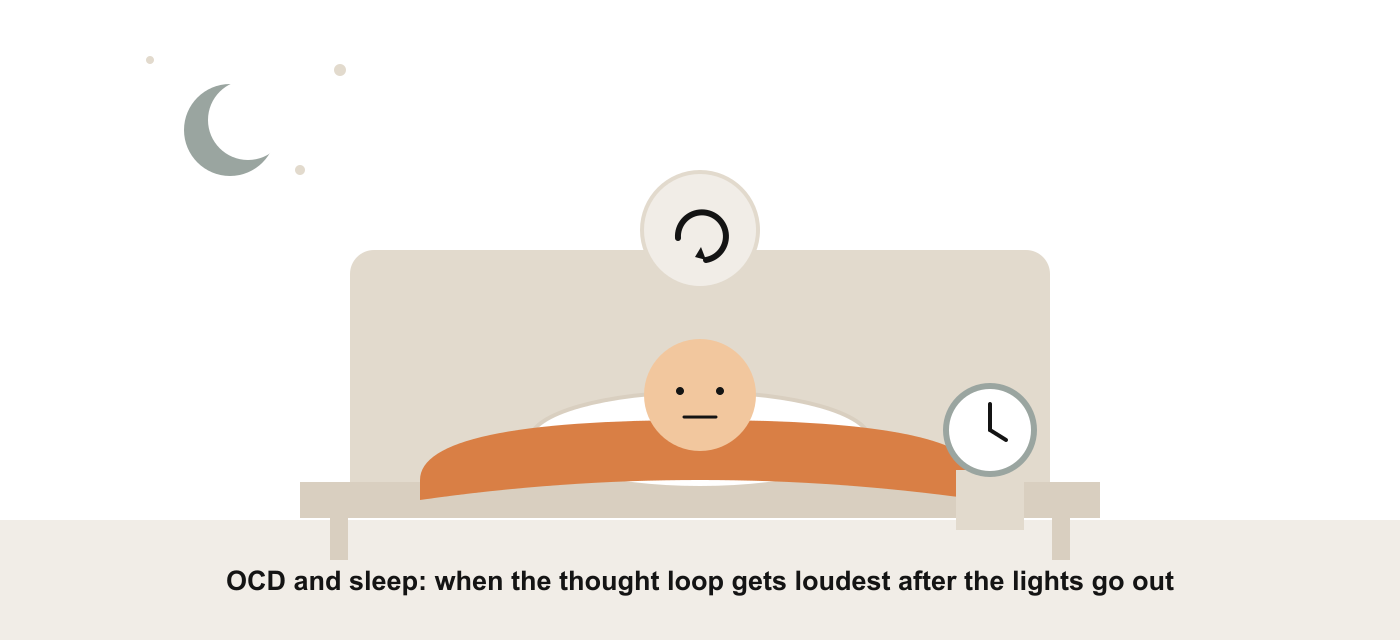
OCD and sleep have a complicated relationship, and most of it runs one direction: bedtime makes OCD worse, not better. The distractions of the day are gone, the room is quiet, and there is nothing left to compete with an obsessive thought for your attention. For a lot of people with OCD, the hour before sleep is when checking rituals stretch longest, intrusive thoughts get loudest, and a straightforward task like turning off the light turns into something that takes an hour it should not take.
This is not a character flaw or a sign that your OCD is getting worse overall. It is a predictable pattern with real research behind it, and it responds to the same specialist treatment that works for OCD during the day. Knowing why nights are different, what the real signs of OCD-driven sleep trouble look like, and how it differs from ordinary insomnia is the first step toward getting the right kind of help instead of just losing more sleep over it.
Quick answer: OCD and sleep problems feed each other in both directions. Bedtime removes the daytime distractions that normally compete with intrusive thoughts, which is why checking, counting, and reassurance-seeking rituals often intensify right before sleep. Real research also shows the reverse: a later, more disrupted bedtime is linked to weaker next-day control over obsessions and compulsions.
The clearest signs that OCD, not ordinary insomnia, is behind your sleep trouble include a bedtime routine that keeps growing longer, specific rituals you have to finish before you feel able to stop, and intrusive thoughts that follow a repeating theme rather than general worry. Specialist, ERP-based OCD treatment is usually what actually breaks the pattern, since general sleep hygiene advice does not touch the compulsions driving it.
Why OCD and Sleep Problems Show Up Together So Often
During the day, there is almost always something else happening: work, conversation, errands, noise. None of that makes OCD disappear, but it gives the mind somewhere else to go, which makes an intrusive thought easier to let pass without fully engaging with it. Bedtime strips all of that away. The room goes quiet, the to-do list stops, and the one thing left to focus on is often whatever thought has been circling all day.
That quiet is exactly the condition under which obsessions tend to get loudest. A thought that was background noise at 2pm can become the only thing in the room at 11pm. For a lot of people, this is the first time they notice how much daytime activity had actually been masking the severity of their OCD rather than genuinely managing it.
The Real Research Behind OCD and Sleep
This is not just a feeling people describe. A sleep-diary study led by psychologist Meredith Coles at Binghamton University followed 20 people diagnosed with OCD and 10 with subthreshold symptoms for a week, tracking bedtimes and daily ratings of how well they could control their obsessions and compulsions. The previous night's bedtime significantly predicted the next day's perceived control, and around 40 percent of the sample met criteria for a delayed sleep phase pattern, going to bed around 3am on average.
The sample was small, so this should be read as a real, documented association rather than definitive proof that late bedtimes cause worse OCD. Still, it lines up with what a lot of people living with OCD already notice: a late, disrupted night tends to be followed by a harder day. The International OCD Foundation has funded research into exactly this question, treating sleep and circadian disruption as a genuine vulnerability factor for OCD rather than a side issue to deal with later.
What OCD and Sleep Trouble Actually Looks Like at Night
Nighttime OCD rarely looks like one single symptom. It usually shows up as a cluster of behaviours that stack on top of each other and stretch out the time between getting into bed and actually falling asleep.
Partners and family members are often the first to notice how far OCD and sleep problems have stretched, simply because they are the ones waiting outside a bathroom door at midnight or being asked, again, whether the front door is really locked. A person living with it day to day can lose track of how long the routine has become, since each individual check feels small on its own. Someone watching from outside often sees the pattern first: forty minutes to leave a room that used to take two.
Checking rituals that have to be repeated at bedtime specifically: doors, windows, appliances, phone settings, even though the same checks were already done earlier in the day.
Intrusive thoughts with a specific, repeating theme, often about harm, contamination, or something terrible happening overnight, rather than general worry about tomorrow.
A bedtime routine that keeps growing: what used to take ten minutes now takes forty, because a step gets added or repeated until it feels right.
Mental rituals done lying in the dark: silently repeating phrases, reviewing the day for mistakes, or running through reassurance in your head until it feels complete.
Waking in the night to re-check something, even when the original check was already thorough.
A sense of dread about going to bed itself, separate from being tired, because bedtime has become associated with where the OCD gets worst.
Why Compulsions Intensify Right Before Bed
Compulsions exist to reduce the anxiety an obsession creates, at least temporarily. During the day, a compulsion often gets interrupted: a phone call, a meeting, someone walking into the room. That interruption is not a cure, but it does put a natural ceiling on how long a ritual can run.
At bedtime, that ceiling disappears. There is no interruption coming, no reason you have to stop, and the one task left on the agenda, going to sleep, cannot start until the ritual feels finished. That combination of unlimited time and nothing else competing for attention is exactly why checking, counting, and reviewing rituals tend to stretch longest in the final hour before sleep, even in people whose daytime OCD feels comparatively manageable.
When Bedtime Itself Becomes a Trigger
Over time, a pattern like this can turn bedtime into its own trigger, separate from whatever the original obsession was about. If going to bed has repeatedly meant an hour of checking and dread, the brain starts to anticipate that struggle the moment the lights go off, which can create anxiety about sleep itself on top of whatever OCD theme started the cycle.
This is one of the reasons OCD-related sleep trouble tends not to improve just by getting more tired or more disciplined about a bedtime routine. The anxiety is not really about tiredness. It is about an environment that has become associated, through repetition, with a specific kind of distress.
7 Real Signs OCD, Not Ordinary Insomnia, Is Behind Your Sleep Trouble
Plenty of things disrupt sleep that have nothing to do with OCD. These are the patterns that point more specifically toward OCD as the real driver, rather than general stress or a poor sleep schedule.
The time it takes to actually get into bed and turn off the light has been growing for weeks or months, not just on one bad night.
There are specific steps you feel you must complete, in a particular order, before you can let yourself try to sleep.
The thoughts keeping you awake follow a repeating theme, the same fear or image returning most nights, rather than a different worry each time.
You have woken up specifically to re-check something already checked, more than once in the same night.
Family members or a partner have noticed or been asked to take part in a bedtime ritual, such as confirming something is locked or safe.
You feel a sense of dread about bedtime arriving, distinct from simply being tired or not wanting the day to end.
Daytime fatigue from lost sleep has started affecting your ability to resist compulsions during the day, creating a cycle rather than a one-off bad patch.
Telling OCD-Driven Sleep Trouble Apart From Ordinary Insomnia
Ordinary insomnia, the kind covered on the NHS's own page on insomnia, usually involves a racing mind, general worry, or an irregular schedule, and it tends to respond to standard sleep hygiene changes: a consistent bedtime, less screen time, a cooler room. OCD-driven sleep trouble often does not respond to any of that, because the problem is not really about sleep hygiene. It is about a ritual that has to be completed before the mind will allow sleep to happen.
A useful, informal distinction is whether the thing keeping you up has a specific theme and a specific ritual attached to it, which points toward OCD, or whether it is a more general, shifting kind of worry about work, money, or the day ahead, which points more toward ordinary stress-related insomnia. Many people have some of both, which is exactly why a proper assessment is more reliable than trying to work it out alone at 1am.
Why General Sleep Advice Often Falls Short Here
Most sleep hygiene advice assumes the obstacle is a racing mind or a poorly timed body clock, and it offers tools built for that: dimmer lights, no caffeine after midday, a wind-down routine. None of that is wrong, and some of it can genuinely help at the margins. But none of it touches the actual mechanism keeping someone with OCD awake, which is a compulsion that has to run its course before the anxiety driving it will quiet down.
This is why people with OCD-related insomnia often report trying every standard sleep tip without much change. The advice is aimed at the wrong target. Treating the OCD itself, rather than treating the sleeplessness as a standalone problem, is usually what actually moves the needle, because it addresses the compulsion rather than working around it.
It is also why a generalist GP visit about "trouble sleeping" can go nowhere for months. If the conversation never mentions the checking, counting, or repeating that is actually filling that hour before bed, the advice offered will keep targeting ordinary insomnia instead of the OCD underneath it. Naming OCD and sleep as the real combination at play, rather than describing it only as tiredness or stress, is often what finally points a GP or therapist toward the right kind of referral.
How Specialist OCD Treatment Helps
OCD Excellence has worked in OCD specifically since 2003, and every therapist on the team has either lived experience of OCD or has cared for someone close to them who has it. That matters here because nighttime OCD is easy to misread as a sleep problem, a stress problem, or simple tiredness, when the actual driver is the same obsessive-compulsive cycle that shows up during the day, just concentrated into the one part of the day with the least distraction.
Exposure and Response Prevention, the treatment that research consistently shows works best for OCD, can be built around a bedtime routine specifically: gradually reducing a checking ritual, sitting with the discomfort of going to bed before a mental review feels complete, and breaking the association between bedtime and dread one step at a time. You can read more about who we treat and how if you want a fuller picture of what a specialist assessment actually involves before deciding whether it is the right next step.
When to Get Help
If bedtime has turned into something you dread, if a routine that used to take minutes now takes an hour or more, or if lost sleep is starting to affect your ability to manage OCD during the day as well, that is a reasonable point to seek a proper assessment rather than continuing to manage it alone.
It is worth saying plainly that struggling with this does not mean you have done anything wrong, and it is not a sign that your OCD has suddenly become unmanageable. It is a well-documented pattern with real research behind it, and it responds to the right treatment in the same way daytime OCD does. Losing an hour or more to a bedtime routine most nights is not a small inconvenience to push through alone indefinitely, it is a genuine symptom worth bringing to a specialist.
If sleeplessness is ever accompanied by thoughts of harming yourself, or you simply do not feel safe, that goes beyond what any article can responsibly help with. Contact your GP urgently, call 111, or in the UK reach the Samaritans free, any time, on 116 123. That support exists exactly for moments like this.
If nights have become the hardest part of living with OCD, the most useful next step is usually a specialist OCD assessment, not another sleep hygiene checklist. Our post on what OCD therapy actually involves covers what a properly structured course of treatment looks like, and our post on OCD and depression covers what can happen when lost sleep and unmanaged OCD start affecting mood as well.
Common Questions About OCD and Sleep
Does OCD really get worse at night, or does it just feel that way?
Both are true at once. It genuinely does get worse for many people, because the distractions that normally compete with obsessions during the day are gone, and real research links later, more disrupted sleep with weaker next-day control over OCD symptoms.
Why do checking rituals take so much longer right before bed?
Because nothing is left to interrupt them. During the day a compulsion often gets cut short by something else demanding attention. At bedtime there is no natural stopping point until the ritual itself feels finished, which is why it can stretch far longer than the same ritual would during the day.
Is lack of sleep making my OCD worse, or is OCD making it hard to sleep?
Usually both, running in a loop. OCD-driven rituals delay sleep, and the resulting tiredness then makes it harder to resist compulsions the next day, which feeds back into another difficult night. Breaking the cycle generally means treating the OCD directly rather than trying to out-sleep it.
Will melatonin or sleep medication fix OCD-related insomnia?
It may help with the sleep timing itself in some cases, but it will not address the compulsions causing the delay in the first place. Any medication decision should go through a GP or psychiatrist who knows your full history, not general information here.
Should I treat the insomnia first or the OCD first?
In most cases the OCD is the more useful place to start, since the sleep trouble is usually a downstream effect of the compulsions rather than an independent problem. A proper assessment is the reliable way to confirm that for your specific situation.
How do I know if it is just a bad night or something more serious?
An occasional bad night happens to everyone and usually resolves on its own. A pattern that has lasted weeks, keeps growing longer, or follows the same repeating ritual or thought most nights is a reasonable point to seek a proper assessment rather than waiting to see if it passes.


Comments